Friday, July 2, 2010

Bureaucratic / Political deadlock


Initiating an (official) University degree in Spain requires permission at three levels, once all internal barriers (the universities' own committees and boards) have been dealt with: the regional autonomous government which ratifies the economic and educational justification, the University quality board at national level and finally a verification, again by the local government, where compliance with all regulations is checked.

What are the advantages of an official title? You will get a document signed by the King of Spain, normally not earlier than two years after completing your studies because of a centralized process. Holders will have access to State exams to enter into the Civil Service. Besides that, an official title gives prestige, and is frequently displayed on office walls, a custom in other countries only known in barber shops.

Earlier this year we applied for authorization of an official Degree in "Management of Hospitality Businesses". We went past step 1, but at step 2 this denomination was not approved since it was too similar to "Business Management". There are no legal grounds for this objection, for the denomination of university titles has been liberalized with Bologna.

We were obliged to call the degree "Tourist and Hotel Management". It is likely that this new denomination will lead to objections or a veto from the local Government. The reason will be the use of the word "Tourism"; they are reluctant to allow titles that may compete with their own Tourist schools.

Negotiations are currently in progress. The results are unknown, except for one certainty bureaucracies always give: delays.

Saturday, May 22, 2010

Research Interests

My research interests in a broad sense are related to understanding the development of social theory in a historical context. In my studies of Spanish history, I have been especially interested in the censorship phenomenon, not only by analyzing censorship criteria and mechanisms, but also its repercussions in the development of political and social theory.

More recently my attention has shifted to Intercultural Communication. I found that the explanation of cultural differences in this new discipline is weak or non-existent (“historically eclectic”, as Hofstede states). I am interested in understanding whether observing and measuring cultural behaviour lead to valid conclusions, and to what extent these observations are determined by cultural perspective.

At the same time, my professional interest in the development of higher education curricula has led me to explore the relation between academic learning and professional performance. I especially seek to understand the development of managerial expertise and to apply these findings in the design of hospitality programs.

Friday, May 14, 2010

Dostoyevski Murals too grim

Pictures of the new Dostoyevski murals in the new Moscow metro station. As many other stations, it looks impressive and somewhat intimidating. I hope we actually get to see the greyscale marbles, in spite of the fear of side-effects.
According to the Moscow Times, the opening of the new Dostoyevskaya station in the Moscow metro was cancelled over fears that the grim murals may lead to suicides. The controversy started after pictures of the construction site (including the murals) were published on a blog at http://d0cent.livejournal.com/124730.html:
Достоевская

Достоевская

Wednesday, May 12, 2010

I-Shou University

Last May 6 and 7 I visited I-Shou University in Kaohsiung, Taiwan. I gave two guest lectures on "Intercultural Communication" and "Learning Management and Becoming a Manager: Two Different Things".

I-Shou University is part of a large complex on the outskirts of Kaohsiung, Taiwan's second city, with the University (15,000 students), an international school, a hospital, a 4 and a 5 star hotel, a mall and a theme park (both to be opened soon), all owned by the same investor. I understand that the "E" in E-Da World (name of the theme park and mall) refers to the owner, "Da" standing for "big". As all (167!) Taiwanese universities, I-Shou faces the problem of adverse demographics and has opted for an active internationalization policy. Our cooperation is the result of this, and I hope this experience will be extended to the international school and ours in Madrid.

My visit was to the International College of the university. Hard to tell, from a short visit, how good a university really is; facilities are hardly an indicator. I was impressed by the I-Shou students, who not only showed up in large numbers on their (lecture-free) Friday, right before the Mothers' Day weekend, but also asked serious questions. The first thing, almost unthinkable in Europe, the latter very rare; one should expect this to be even harder for more introverted students.

We have two students now doing their internship at the Crowne Plaza during its (sometimes chaotic) opening stage. "After this", they confided me, "we can face any challenge in the world".

Come on, kids, there is the garbage truck!

http://farm4.static.flickr.com/3110/2838598041_bce8cdb466.jpg?v=0A cross-cultural experience in Taiwan.
A happy melody sounds through the streets, kids come running out of their houses. In stead of coins for the ice-cream vendor they hold garbage bags.

Monday, May 3, 2010

A Sampling of Chinglish

For the last two years, the Shanghai Commission for the Management of Language Use has been trying to clean up English-language signs and menus to rid them of their malapropisms, like these examples.

Source: New York Times, http://www.nytimes.com/slideshow/2010/05/03/world/asia/20100503_CHINGLISH.html

Friday, April 30, 2010

Working Internationally: the W-Curve

Reflection on the W-Curve of students during exchanges and traineeships abroad


The so-called W-curve is a known phenomenon in literature on expat experiences. Originally it was thought of as a V, reflecting the deep crisis people may go through at the start of their international experience. It turned into a double-U when researchers realised that this crisis would repeat when expats went home after a prolonged stay abroad.

That the W is a reality is something that I have not only experienced for myself; I have tutored many Ws over the years, mainly with Dutch students. The last few years, working with Spanish students, I have noticed a differently shaped, assymetric W though. The homesickness crisis being more profound, home (family) support will not seek to help the individual overcome the crisis, but will exercise pressure to avoid it alltogether by cancelling the international experience.

This can be interpreted as a consequence of the Individualism-Collectivism dimension. Education is not the start of an individual venture, but a socialization aimed at providing the community member with a set of commonly recognizable experiences, and the documents to prove it.

This may be an element that seriously affects both the individual's and the community's competitiveness. I believe we as educators should insist on the development of personal autonomy through international experiences.

Friday, November 20, 2009

Escuela de Hotelería: donde aprender el oficio

Interview in the Quehotelreservo-blog (Argentina), about the orientation of Zaragoza Hotel Management School, and our use of social media.
Por Brenda Zaniuk, el 20 de Noviembre de 2009

La Hotelería nos ocupa a todos dado que es uno de los servicios necesarios y más fuertemente vinculados al Turismo; incluso aunque no nos ocupemos en el rubro.
El Blog de la Escuela de Hoteleria
Y es que es gracias a estos establecimientos que las diversas zonas turísticas de nuestro país pueden surgir, resurgir o mejorar su perfil turístico, pues un huésped bien atendido no sólo volverá sino que, además, hará la recomendación.
Con igual preocupación, dedicación y ocupación, las Escuelas de Hotelería preparan a los profesionales que mejorarán los servicios del sector y es por esta razón que hemos querido conocer más acerca del enfoque que estos profesionales tienen del turismo en España.
Para esta misión, entrevistamos a Jeroen Oskam, responsable de una Escuela de Hotelería, Zaragoza Hotel Management Group, iniciativa conjunta del Grupo Lezama (restaurantes y hoteles en España y EEUU) y de la fundación Universidad San Jorge, Zaragoza, así como de su blog Dirección Hotelera.
En esta Escuela de Hotelería se trabaja para “introducir en España un modelo innovador de formación para la profesión hotelera con estudios empresariales, a nivel universitario, especializados en este sector”.
- ¿Cómo surgió la idea/necesidad de hacer un blog? ¿Qué objetivo persigue con el mismo?

- Hay dos razones
. Primero, al ser innovadora la orientación de nuestros estudios, necesitábamos un medio para explicar lo que estamos haciendo.

Perfil de la Escuela en Facebook

Friday, November 13, 2009

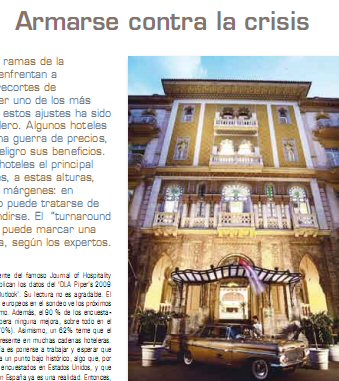
'Turnaround management', o cómo armarse contra la crisis

At Zaragoza Hotel Management School, we cooperated with Hotelschool the Hague Research (Jean-Pierre van der Rest) in the adaptation of his articles on Turnaround Management for the Spanish professional press (Hosteltur):

Para algunos hoteles el principal problema no es, a estas alturas de la crisis financiera y económica, mantener sus márgenes. En este momento puede tratarse de salvarse o hundirse. El  'turnaround management' puede marcar una gran diferencia, según los expertos. ¿Cuáles son sus respuestas a las 20 preguntas críticas que debería plantearse?
Hay muchas posibilidades para hacer frente a la crisis. Los profesores de Gestión Hotelera Dr. Jan Adriaanse (Universidad de Leiden), Dr. Jean-Pierre van der Rest (Escuela de Dirección y Administración Hotelera de La Haya), Dr. Frans van den Broek (Escuela de Dirección y Administración Hotelera de La Haya) y Dr. Jeroen Oskam (Escuela de Dirección Hotelera de Zaragoza), aseguran que es necesario aproximarse a la crisis desde el campo especializado del “turnaround management” o gestión para la reversión de la crisis, y aplicar este conocimiento en la práctica habitual de aquellos hoteles que aún siguen funcionando de manera saludable.

Thursday, September 24, 2009

Start of the European Bachelor of Hospitality Management

September 23, 2009: First start of this joint program. Pictures, news article and a news item on French TV3.
Studying in three countries, three languages and three cultures: today we inaugurated the new European Bachelor of Hospitality Management at L'École de Savignac, Savignac-les-Églises (close to Perigueux), France. The program, which leads to the BA Hons. awarded by the University of Brighton, starts in France, with its second year in Zaragoza, Spain, and the final year in Brighton, UK.


Inauguración Oficial European Bachelor of Hospitality Management (France 3)


Savignac-les-Églises, France.

Saturday, June 6, 2009

Recruitment Day Disneyland Paris

In cooperation with Disneyland Paris and INAEM (Government Employment Agency), ZHMS organized a recruitment day at national level, which attracted students from cities as far away as Vigo or Cádiz (1.000 kms.). In this fragment, Aragon TV interviews Rosa Maria Antunes (Disney Casting), several candidates and myself.

Sunday, January 18, 2009

Franco's meedogenloze terreur

Book review of Víctimas de la guerra civil by Santos Juliá, in Dutch national newspaper De Volkskrant. Our book on Spanish history is quoted as an "independent" source, even though the number of war victims has to be corrected upward in view of more recent research:
 
RECENSIE, Sander de Vaan
op 30 april '99, 00:00, bijgewerkt 17 januari '09, 23:19


OP 1 APRIL was het zestig jaar geleden dat de Spaanse burgeroorlog werd beeindigd. De herdenkingen vonden grotendeels in beperkte kring plaats, want de meeste Spanjaarden denken nog altijd niet graag terug aan deze gruwelijke broederstrijd.

Tijdens de dictatuur van Franco (1939-1975) was iedere discussie over de oorlog uit den boze. Maar ook na het herstel van dedemocratie bleef het conflict een tere kwestie. Het gros van de bevolking besloot na de dood van de dictator haast instinctief het verleden te 'vergeten'.

Wednesday, December 10, 2008

Hostelería y Turismo: dos disciplinas diferentes

Discussion article in the Comunidad-Hosteltur Forum, on the fact that Spanish Universities offered "Tourism" but not "Hospitality" as an independent field of study.
A nadie se le ocurriría decir que en Cornell o en Lausanne se estudia "Turismo". No obstante, aquí se suele pensar que para tareas de gestión en hoteles hay que estudiar "Turismo", y para ser cocineros o camareros, "Hostelería".

Para mí, hay tres malentendidos fundamentales. En primer lugar, si los clientes de un hotel no son turistas (sino gente de negocios, participantes en un congreso, delegaciones oficiales etc.), el hotel desde luego no es un "establecimiento turístico".

En segundo lugar, en las escuelas de turismo no se enseña gestión. Lo que llamamos "gestión" es saber trabajar con gente; el resto, como contabilidad,derecho mercantil e incluso muchas materias denominadas "gestión de ...", son asignaturas de "Administración". Es otra cosa.

Esta confusión tiene que ver con la idea absurda que todo trabajo con papel sea noble, y otras tareas manuales, de un nivel inferior. Por supuesto, rellenar un excel no es menos operativo que hacer una tortilla francesa. Sin embargo, hay quienes piensan que teclear es gestionar.

Finalmente, el tercer malentendido es que gestionar actividades turísticas es parecido a gestionar empresas hoteleras. En España, las escuelas de turismo surgieron en los años sesenta, en el auge del propio turismo: había que convertir pescadores en hosteleros. El método era el mismo: si antes había que echar la red donde había migraciones de peces, ahora se construían hoteles donde había movimientos turísticos. La asignatura de "Sociología del Turismo" es precisamente el estudio de estas migraciones.

Por esto, la carrera de Turismo no siempre es una adecuada preparación para trabajar en hoteles; para dirigirlos, mucho menos.

[Comunidad Hosteltur]

Tuesday, November 18, 2008

¡ATENCION! Vd. está abandonando el sector de la realidad. Está entrando en el sector de la enseñanza.

Why do lazy professors start their lectures with a dictionary definition?
Los profesores perezosos o algo inseguros suelen empezar sus clases con alguna definición. ¿Hablamos de hoteles hoy? Venga: "Un establecimiento hotelero es aquel dedicado de modo profesional y habitual al alojamiento de personas en contraprestación de un precio previamente pactado". ¿Turismo sostenible? Otra: "Característica o estado según el cual pueden satisfacerse las necesidades de la población actual y local etcétera etcétera". Incluso he visto clases sobre pensamiento creativo que empezaban con una definición de creatividad.
¿Por qué importa? No me gusta porque es un comodín que no sirve para nada. Si tienes un aula llena de estudiantes de gestión de hoteles, me imagino que tendrán alguna noción de lo que es un hotel, y no abres ninguna perspectiva nueva mediante tu definición. Y es que las definiciones usadas no son ejercicios intelectuales del profesor en cuestión, sino frases copiadas de algún diccionario, o, en el caso de los más modernos, de Wikipedia.
 El mensaje es el siguiente: Aquí se empieza desde cero. No somos un grupo de profesionales, o por lo menos interesados en el mismo tema que podamos discutir y sacar conclusiones de nuestras experiencias. Todo lo que sabíais, porque a lo mejor ya estabais trabajando en un hotel, o porque algún día habéis leído un libro interesante sobre la materia, ya no cuenta. Vamos a reconstruir vuestra comprensión del hotel a partir de su definición.


Thursday, November 13, 2008

¿Estudios o experiencia?


Explanation of the concept of "Expertise" as discussed by Gijselaers.

Recientemente un director de hotel con muchos años de experiencia me comentó: "A veces me enseñan un Excel, y digo en seguida: el resultado de abajo no puede estar bien". "Pero si lo calcula el ordenador... " "Ya lo sé, cometerá un error, porque no puede ser así". Y un amigo suyo añadió: "Nosotros no sólo siempre sabemos de antemano cuál va a ser el resultado, sino también qué resultado conviene que dé".
La escena no es sorprendente, ya que confirma lo que dicen estudios en ciencias de educación sobre el fenómeno de la expertise, los conocimientos basados en la experiencia.
En un estudio han comparado tres grupos: estudiantes (de Empresariales), recién graduados y profesionales con al menos 10 años de experiencia. Los tres grupos tenían que solucionar casos, y como era de esperar, los graduados lo hacían mejor que los estudiantes, y los profesionales mejor que los recién graduados: tenían más respuestas correctas, y menos respuestas incorrectas.
Pero lo que sí llamaba la atención era que sobre todo los recién graduados cometían otro tipo de error: tenían muchas más respuestas parcialmente correctas que los estudiantes, y que los profesionales.


Monday, November 10, 2008

Teoría y práctica en las carreras de hostelería y turismo

La relación entre teoría y práctica no es una simple cuestión de la gallina o el huevo. Tradicionalmente, siempre había que empezar por la teoría, la sabiduría de siempre, estática y estable. Cuando un estudiante había estudiado la teoría disponible, se le permitía "poner en práctica" lo aprendido. Esta aproximación se conoce como el modelo H, no por la letra sino por su forma, porque la práctica está basada en la teoría, y la repite.


En cambio, en la "sociedad del conocimiento", tenemos que enseñar a nuestros estudiantes a construir nueva teoría, les tenemos que enseñar a aprender. Al fin y al cabo, lo que hoy enseñamos ya tiene una fecha de caducidad, y no les servirá durante toda su vida profesional. Para ello, es necesario que sepan analizar la práctica, y que aprendan a sacar de ella sus propias conclusiones. Las escuelas nos tenemos que situar mucho más cerca de la realidad profesional. Esta aproximación es la que se conoce como el modelo Z:

Más información: conferencia "Cooks that can manage or managers that can cook", EuroCHRIE Leeds 2007 (versión española: "¿Cocineros que gestionan, o directivos que cocinan?") .

[Comunidad Hosteltur]

Thursday, January 31, 2008

Conclusiones del III Foro Nacional de Escuelas de Hostelería AEHOS

Barcelona, 22 y 23 de octubre de 2007
 
 
La Escuela Superior de Hostelería de Barcelona ha acogido en su nueva sede, durante los días 22 y 23 de Octubre, el III Foro Nacional de Escuelas de Hostelería, que con el título “PASADO, PRESENTE Y FUTURO DE LA HOSTELERÍA” ha reunido a varios de los más importantes centros formativos de hostelería de toda España y a destacados representantes del sector hostelero y turístico de nuestro país.
 
Definitivamente, y en palabras de nuestro ex presidente D. Kepa Olabarrieta, los Foros se han constituido en la plataforma idónea para la puesta en común de problemáticas generales y comunes a todas las Escuelas de Hostelería, independientemente de su tipología y ubicación geográfica.

LUNES 22  DE OCTUBRE
 
9.30 – 9.45 Bienvenida y presentación del Foro Barcelona 2007 – A cargo de D. Kepa Olabarrieta, Ex Presidente de la Asociación de Escuelas de Hostelería (AEHOS).
 
9.45 – 11.00 Ponencia “De los recursos humanos a los humanos con recursos”. A cargo del Prof. Doménec Biosca, Presidente Fundador de la Asociación de Directivos de Empresas Turísticas (ADETUR).
 
11.30 – 12.45 Coloquio – Dirigido por el Prof. Doménec Biosca, Coordinador General de la Confederación Empresarial de Hostelería y Restauración de Cataluña.

13.00 – 14.00 Ponencia y coloquio “Teoría y práctica en las carreras universitarias” – A cargo del Prof. Jeroen Oskam, Director Académico de Estudios Superiores de la Escuela de Hostelería de Zaragoza.
 
MARTES  23  DE OCTUBRE
9.30 – 10.30 Ponencia y coloquio “Recursos humanos y formación en hostelería: asignatura pendiente” – A cargo de José María Rubio, Presidente de la Federación Española de Hostelería – FEHR.

11.00 – 11.45 Ponencia “La formación y la adaptación al mundo del trabajo” – A cargo de D. Oriol Crespo, Jefe de Cocina de El Bulli (Tarragona) – Tres estrellas Michelin - .
 
11.45 – 12.30  Ponencia “La relación Escuela / Restaurante: pasado, presente y futuro” – A cargo de D. Pedro Monje, co-gerente del Rest. Via Véneto (Barcelona) - Premio Nacional de Gastronomía y Premio al Mejor Equipo de Sala del 2003 - .
 
12.30 – 13.30 Coloquio – Dirigido por D. Francisco Orobitg, Presidente de AEHOS.

Resumen de las conclusiones: http://www.aehos.es/forobarcelona/CONCLUBARNA.pdf.

Tuesday, October 2, 2007

Saturday, September 1, 2007