Wednesday, May 12, 2010
Come on, kids, there is the garbage truck!
A happy melody sounds through the streets, kids come running out of their houses. In stead of coins for the ice-cream vendor they hold garbage bags.
 A cross-cultural experience in Taiwan.
Monday, May 3, 2010
A Sampling of Chinglish
For the last two years, the Shanghai Commission for the Management of Language Use has been trying to clean up English-language signs and menus to rid them of their malapropisms, like these examples.

Source: New York Times, http://www.nytimes.com/slideshow/2010/05/03/world/asia/20100503_CHINGLISH.html
Friday, April 30, 2010
Working Internationally: the W-Curve
Reflection on the W-Curve of students during exchanges and traineeships abroad

The so-called W-curve is a known phenomenon in literature on expat experiences. Originally it was thought of as a V, reflecting the deep crisis people may go through at the start of their international experience. It turned into a double-U when researchers realised that this crisis would repeat when expats went home after a prolonged stay abroad.
That the W is a reality is something that I have not only experienced for myself; I have tutored many Ws over the years, mainly with Dutch students. The last few years, working with Spanish students, I have noticed a differently shaped, assymetric W though. The homesickness crisis being more profound, home (family) support will not seek to help the individual overcome the crisis, but will exercise pressure to avoid it alltogether by cancelling the international experience.
This can be interpreted as a consequence of the Individualism-Collectivism dimension. Education is not the start of an individual venture, but a socialization aimed at providing the community member with a set of commonly recognizable experiences, and the documents to prove it.
This may be an element that seriously affects both the individual's and the community's competitiveness. I believe we as educators should insist on the development of personal autonomy through international experiences.
Friday, November 20, 2009
Escuela de Hotelería: donde aprender el oficio
Interview in the Quehotelreservo-blog (Argentina), about the orientation of Zaragoza Hotel Management School, and our use of social media.
Por Brenda Zaniuk, el 20 de Noviembre de 2009La Hotelería nos ocupa a todos dado que es uno de los servicios necesarios y más fuertemente vinculados al Turismo; incluso aunque no nos ocupemos en el rubro.

El Blog de la Escuela de Hoteleria
Con igual preocupación, dedicación y ocupación, las Escuelas de Hotelería preparan a los profesionales que mejorarán los servicios del sector y es por esta razón que hemos querido conocer más acerca del enfoque que estos profesionales tienen del turismo en España.
Para esta misión, entrevistamos a Jeroen Oskam, responsable de una Escuela de Hotelería, Zaragoza Hotel Management Group, iniciativa conjunta del Grupo Lezama (restaurantes y hoteles en España y EEUU) y de la fundación Universidad San Jorge, Zaragoza, así como de su blog Dirección Hotelera.
En esta Escuela de Hotelería se trabaja para “introducir en España un modelo innovador de formación para la profesión hotelera con estudios empresariales, a nivel universitario, especializados en este sector”.
- ¿Cómo surgió la idea/necesidad de hacer un blog? ¿Qué objetivo persigue con el mismo?
- Hay dos razones. Primero, al ser innovadora la orientación de nuestros estudios, necesitábamos un medio para explicar lo que estamos haciendo.

Perfil de la Escuela en Facebook
Friday, November 13, 2009
'Turnaround management', o cómo armarse contra la crisis
At Zaragoza Hotel Management School, we cooperated with Hotelschool the Hague Research (Jean-Pierre van der Rest) in the adaptation of his articles on Turnaround Management for the Spanish professional press (Hosteltur):
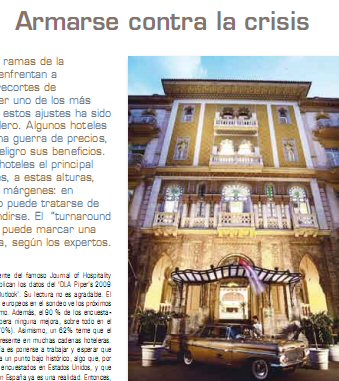
Para algunos hoteles el principal problema no es, a estas alturas de la crisis financiera y económica, mantener sus márgenes. En este momento puede tratarse de salvarse o hundirse. El 'turnaround management' puede marcar una gran diferencia, según los expertos. ¿Cuáles son sus respuestas a las 20 preguntas críticas que debería plantearse?
Hay muchas posibilidades para hacer frente a la crisis. Los profesores de Gestión Hotelera Dr. Jan Adriaanse (Universidad de Leiden), Dr. Jean-Pierre van der Rest (Escuela de Dirección y Administración Hotelera de La Haya), Dr. Frans van den Broek (Escuela de Dirección y Administración Hotelera de La Haya) y Dr. Jeroen Oskam (Escuela de Dirección Hotelera de Zaragoza), aseguran que es necesario aproximarse a la crisis desde el campo especializado del “turnaround management” o gestión para la reversión de la crisis, y aplicar este conocimiento en la práctica habitual de aquellos hoteles que aún siguen funcionando de manera saludable.
Thursday, September 24, 2009
Start of the European Bachelor of Hospitality Management
September 23, 2009: First start of this joint program. Pictures, news article and a news item on French TV3.
Studying in three countries, three languages and three cultures: today we inaugurated the new European Bachelor of Hospitality Management at L'École de Savignac, Savignac-les-Églises (close to Perigueux), France. The program, which leads to the BA Hons. awarded by the University of Brighton, starts in France, with its second year in Zaragoza, Spain, and the final year in Brighton, UK.
Saturday, June 6, 2009
Recruitment Day Disneyland Paris
In cooperation with Disneyland Paris and INAEM (Government Employment Agency), ZHMS organized a recruitment day at national level, which attracted students from cities as far away as Vigo or Cádiz (1.000 kms.). In this fragment, Aragon TV interviews Rosa Maria Antunes (Disney Casting), several candidates and myself.
Sunday, January 18, 2009
Franco's meedogenloze terreur
Book review of Víctimas de la guerra civil by Santos Juliá, in Dutch national newspaper De Volkskrant. Our book on Spanish history is quoted as an "independent" source, even though the number of war victims has to be corrected upward in view of more recent research:

RECENSIE, Sander de Vaan
op 30 april '99, 00:00, bijgewerkt 17 januari '09, 23:19
OP 1 APRIL was het zestig jaar geleden dat de Spaanse burgeroorlog werd beeindigd. De herdenkingen vonden grotendeels in beperkte kring plaats, want de meeste Spanjaarden denken nog altijd niet graag terug aan deze gruwelijke broederstrijd.
Tijdens de dictatuur van Franco (1939-1975) was iedere discussie over de oorlog uit den boze. Maar ook na het herstel van dedemocratie bleef het conflict een tere kwestie. Het gros van de bevolking besloot na de dood van de dictator haast instinctief het verleden te 'vergeten'.
Wednesday, December 10, 2008
Hostelería y Turismo: dos disciplinas diferentes
Discussion article in the Comunidad-Hosteltur Forum, on the fact that Spanish Universities offered "Tourism" but not "Hospitality" as an independent field of study.
A nadie se le ocurriría decir que en Cornell o en Lausanne se estudia "Turismo". No obstante, aquí se suele pensar que para tareas de gestión en hoteles hay que estudiar "Turismo", y para ser cocineros o camareros, "Hostelería".Para mí, hay tres malentendidos fundamentales. En primer lugar, si los clientes de un hotel no son turistas (sino gente de negocios, participantes en un congreso, delegaciones oficiales etc.), el hotel desde luego no es un "establecimiento turístico".
En segundo lugar, en las escuelas de turismo no se enseña gestión. Lo que llamamos "gestión" es saber trabajar con gente; el resto, como contabilidad,derecho mercantil e incluso muchas materias denominadas "gestión de ...", son asignaturas de "Administración". Es otra cosa.Esta confusión tiene que ver con la idea absurda que todo trabajo con papel sea noble, y otras tareas manuales, de un nivel inferior. Por supuesto, rellenar un excel no es menos operativo que hacer una tortilla francesa. Sin embargo, hay quienes piensan que teclear es gestionar.
Finalmente, el tercer malentendido es que gestionar actividades turísticas es parecido a gestionar empresas hoteleras. En España, las escuelas de turismo surgieron en los años sesenta, en el auge del propio turismo: había que convertir pescadores en hosteleros. El método era el mismo: si antes había que echar la red donde había migraciones de peces, ahora se construían hoteles donde había movimientos turísticos. La asignatura de "Sociología del Turismo" es precisamente el estudio de estas migraciones.Por esto, la carrera de Turismo no siempre es una adecuada preparación para trabajar en hoteles; para dirigirlos, mucho menos.
Tuesday, November 18, 2008
¡ATENCION! Vd. está abandonando el sector de la realidad. Está entrando en el sector de la enseñanza.
Why do lazy professors start their lectures with a dictionary definition?
Los profesores perezosos o algo inseguros suelen empezar sus clases con alguna definición. ¿Hablamos de hoteles hoy? Venga: "Un establecimiento hotelero es aquel dedicado de modo profesional y habitual al alojamiento de personas en contraprestación de un precio previamente pactado". ¿Turismo sostenible? Otra: "Característica o estado según el cual pueden satisfacerse las necesidades de la población actual y local etcétera etcétera". Incluso he visto clases sobre pensamiento creativo que empezaban con una definición de creatividad.¿Por qué importa? No me gusta porque es un comodín que no sirve para nada. Si tienes un aula llena de estudiantes de gestión de hoteles, me imagino que tendrán alguna noción de lo que es un hotel, y no abres ninguna perspectiva nueva mediante tu definición. Y es que las definiciones usadas no son ejercicios intelectuales del profesor en cuestión, sino frases copiadas de algún diccionario, o, en el caso de los más modernos, de Wikipedia.
El mensaje es el siguiente: Aquí se empieza desde cero. No somos un grupo de profesionales, o por lo menos interesados en el mismo tema que podamos discutir y sacar conclusiones de nuestras experiencias. Todo lo que sabíais, porque a lo mejor ya estabais trabajando en un hotel, o porque algún día habéis leído un libro interesante sobre la materia, ya no cuenta. Vamos a reconstruir vuestra comprensión del hotel a partir de su definición.

Thursday, November 13, 2008
¿Estudios o experiencia?
Explanation of the concept of "Expertise" as discussed by Gijselaers.
Recientemente un director de hotel con muchos años de experiencia me comentó: "A veces me enseñan un Excel, y digo en seguida: el resultado de abajo no puede estar bien". "Pero si lo calcula el ordenador... " "Ya lo sé, cometerá un error, porque no puede ser así". Y un amigo suyo añadió: "Nosotros no sólo siempre sabemos de antemano cuál va a ser el resultado, sino también qué resultado conviene que dé".
La escena no es sorprendente, ya que confirma lo que dicen estudios en ciencias de educación sobre el fenómeno de la expertise, los conocimientos basados en la experiencia.
En un estudio han comparado tres grupos: estudiantes (de Empresariales), recién graduados y profesionales con al menos 10 años de experiencia. Los tres grupos tenían que solucionar casos, y como era de esperar, los graduados lo hacían mejor que los estudiantes, y los profesionales mejor que los recién graduados: tenían más respuestas correctas, y menos respuestas incorrectas.
Pero lo que sí llamaba la atención era que sobre todo los recién graduados cometían otro tipo de error: tenían muchas más respuestas parcialmente correctas que los estudiantes, y que los profesionales.

Monday, November 10, 2008
Teoría y práctica en las carreras de hostelería y turismo
La relación entre teoría y práctica no es una simple cuestión de la gallina o el huevo. Tradicionalmente, siempre había que empezar por la teoría, la sabiduría de siempre, estática y estable. Cuando un estudiante había estudiado la teoría disponible, se le permitía "poner en práctica" lo aprendido. Esta aproximación se conoce como el modelo H, no por la letra sino por su forma, porque la práctica está basada en la teoría, y la repite.

En cambio, en la "sociedad del conocimiento", tenemos que enseñar a nuestros estudiantes a construir nueva teoría, les tenemos que enseñar a aprender. Al fin y al cabo, lo que hoy enseñamos ya tiene una fecha de caducidad, y no les servirá durante toda su vida profesional. Para ello, es necesario que sepan analizar la práctica, y que aprendan a sacar de ella sus propias conclusiones. Las escuelas nos tenemos que situar mucho más cerca de la realidad profesional. Esta aproximación es la que se conoce como el modelo Z:
 Más información: conferencia "Cooks that can manage or managers that can cook", EuroCHRIE Leeds 2007 (versión española: "¿Cocineros que gestionan, o directivos que cocinan?") .
[Comunidad Hosteltur]
Thursday, January 31, 2008
Conclusiones del III Foro Nacional de Escuelas de Hostelería AEHOS
Barcelona, 22 y 23 de octubre de 2007
La Escuela Superior de Hostelería de Barcelona ha acogido en su nueva sede, durante los días 22 y 23 de Octubre, el III Foro Nacional de Escuelas de Hostelería, que con el título “PASADO, PRESENTE Y FUTURO DE LA HOSTELERÍA” ha reunido a varios de los más importantes centros formativos de hostelería de toda España y a destacados representantes del sector hostelero y turístico de nuestro país.
Definitivamente, y en palabras de nuestro ex presidente D. Kepa Olabarrieta, los Foros se han constituido en la plataforma idónea para la puesta en común de problemáticas generales y comunes a todas las Escuelas de Hostelería, independientemente de su tipología y ubicación geográfica.
LUNES 22 DE OCTUBRE
9.30 – 9.45 Bienvenida y presentación del Foro Barcelona 2007 – A cargo de D. Kepa Olabarrieta, Ex Presidente de la Asociación de Escuelas de Hostelería (AEHOS).
9.45 – 11.00 Ponencia “De los recursos humanos a los humanos con recursos”. A cargo del Prof. Doménec Biosca, Presidente Fundador de la Asociación de Directivos de Empresas Turísticas (ADETUR).
11.30 – 12.45 Coloquio – Dirigido por el Prof. Doménec Biosca, Coordinador General de la Confederación Empresarial de Hostelería y Restauración de Cataluña.
13.00 – 14.00 Ponencia y coloquio “Teoría y práctica en las carreras universitarias” – A cargo del Prof. Jeroen Oskam, Director Académico de Estudios Superiores de la Escuela de Hostelería de Zaragoza.
MARTES 23 DE OCTUBRE
9.30 – 10.30 Ponencia y coloquio “Recursos humanos y formación en hostelería: asignatura pendiente” – A cargo de José María Rubio, Presidente de la Federación Española de Hostelería – FEHR.
11.00 – 11.45 Ponencia “La formación y la adaptación al mundo del trabajo” – A cargo de D. Oriol Crespo, Jefe de Cocina de El Bulli (Tarragona) – Tres estrellas Michelin - .
11.45 – 12.30 Ponencia “La relación Escuela / Restaurante: pasado, presente y futuro” – A cargo de D. Pedro Monje, co-gerente del Rest. Via Véneto (Barcelona) - Premio Nacional de Gastronomía y Premio al Mejor Equipo de Sala del 2003 - .
12.30 – 13.30 Coloquio – Dirigido por D. Francisco Orobitg, Presidente de AEHOS.
Resumen de las conclusiones: http://www.aehos.es/forobarcelona/CONCLUBARNA.pdf.
La Escuela Superior de Hostelería de Barcelona ha acogido en su nueva sede, durante los días 22 y 23 de Octubre, el III Foro Nacional de Escuelas de Hostelería, que con el título “PASADO, PRESENTE Y FUTURO DE LA HOSTELERÍA” ha reunido a varios de los más importantes centros formativos de hostelería de toda España y a destacados representantes del sector hostelero y turístico de nuestro país.
Definitivamente, y en palabras de nuestro ex presidente D. Kepa Olabarrieta, los Foros se han constituido en la plataforma idónea para la puesta en común de problemáticas generales y comunes a todas las Escuelas de Hostelería, independientemente de su tipología y ubicación geográfica.
LUNES 22 DE OCTUBRE
9.30 – 9.45 Bienvenida y presentación del Foro Barcelona 2007 – A cargo de D. Kepa Olabarrieta, Ex Presidente de la Asociación de Escuelas de Hostelería (AEHOS).
9.45 – 11.00 Ponencia “De los recursos humanos a los humanos con recursos”. A cargo del Prof. Doménec Biosca, Presidente Fundador de la Asociación de Directivos de Empresas Turísticas (ADETUR).
11.30 – 12.45 Coloquio – Dirigido por el Prof. Doménec Biosca, Coordinador General de la Confederación Empresarial de Hostelería y Restauración de Cataluña.
13.00 – 14.00 Ponencia y coloquio “Teoría y práctica en las carreras universitarias” – A cargo del Prof. Jeroen Oskam, Director Académico de Estudios Superiores de la Escuela de Hostelería de Zaragoza.
MARTES 23 DE OCTUBRE
9.30 – 10.30 Ponencia y coloquio “Recursos humanos y formación en hostelería: asignatura pendiente” – A cargo de José María Rubio, Presidente de la Federación Española de Hostelería – FEHR.
11.00 – 11.45 Ponencia “La formación y la adaptación al mundo del trabajo” – A cargo de D. Oriol Crespo, Jefe de Cocina de El Bulli (Tarragona) – Tres estrellas Michelin - .
11.45 – 12.30 Ponencia “La relación Escuela / Restaurante: pasado, presente y futuro” – A cargo de D. Pedro Monje, co-gerente del Rest. Via Véneto (Barcelona) - Premio Nacional de Gastronomía y Premio al Mejor Equipo de Sala del 2003 - .
12.30 – 13.30 Coloquio – Dirigido por D. Francisco Orobitg, Presidente de AEHOS.
Resumen de las conclusiones: http://www.aehos.es/forobarcelona/CONCLUBARNA.pdf.
Tuesday, October 2, 2007
Interview in "A tu Gusto"
Interview in ZTV's A tu gusto, on the start and educational philosophy of Zaragoza Hotel Management School.
Saturday, September 1, 2007
A new and innovative degree
Interview announcing the start of Zaragoza Hotel Management School, September 1, 2007:
Saturday, April 21, 2007
Arrancan los estudios superiores de Hostelería

La sede de la escuela estará en el actual edificio de la Universidad San Jorge.
21/04/2007 EL PERIÓDICOLos alumnos que deseen cursar estudios superiores de Hostelería en Zaragoza podrán hacerlo a partir del próximo mes de septiembre. La sede física de la escuela se ubicará en el actual edificio de la Universidad San Jorge, en la calle Alcalde Sainz de Varanda, aunque la gestionará Hotel Management School, una empresa privada. La universidad abandonó el proyecto de crear una titulación debido a los problemas que tuvo para encontrar una sede apropiada.
El auge del sector de la restauración en la ciudad, fomentado por la llegada de la Expo, ha impulsado la creación de un centro que complementará la oferta de formación profesional que se imparte en Aragón sobre esta materia.
Esta nueva oferta formativa, que tendrá una duración de cuatro años, estará claramente enfocada hacia la gestión de empresas del ramo, englobando desde cuestiones operativas y financieras hasta el liderazgo de un equipo y los conocimientos para crear un negocio propio.
La escuela ofertará tres idiomas, intercambios con las principales universidades extranjeras donde se imparte hostelería y prácticas en empresas internacionales, para lo que ya se han realizado algunos contactos, según explicó Jeroen Oskam, responsable de esta iniciativa.
"Otra de las características de la escuela de estudios superiores serán sus métodos de enseñanza innovadores. Los alumnos analizarán la experiencia de los huéspedes o la creación de empresas a través de modelos de trabajo participativos e interactivos, que fortalecerán la independencia, la creatividad y la proactividad de los estudiantes", señaló Oskam.
La calidad del programa del nuevo centro ha sido avalado por la fundación San Valero, el Grupo Lezama, la Escuela Superior de Hostelería de Sevilla, varias empresas de restauración y la Universidad San Jorge. No obstante, estos estudios no tienen que ver con esta universidad privada, que en su día quiso crear una titulación de Hostelería.
INTENTO FRUSTRADO La Universidad San Jorge intentó en el 2006 poner en marcha una titulación de Hostelería. El problema para encontrar una sede adecuada hizo que la institución desistiera y abandonara el proyecto.
La noticia de crear unos estudios superiores de Hostelería fue muy bien recibida entre los empresarios aragoneses implicados en el negocio de la restauración. El proyecto planteaba la implantación de una carrera de cuatro años de duración. Tres de ellos serían comunes y en el último, los alumnos podrían especializarse en Nutrición o en Gestión de Hoteles.
La universidad se planteó la titulación como una cuestión estratégica que no se quedaría en la Expo sino que dotaría a la comunidad autónoma de un grupo de profesionales de la alta cocina.
Monday, March 28, 2005
Maastricht Hotel Management School Initiates Cooperation with Business School Southeast Missouri State University

Published: 2005-03-29 00:00:00
Last week Prof.dr.Peter Gordon visited the Maastricht Hotel Management School.Peter Gordon is professor in International Marketing and coordinates the international projects of the Business School of Southeast Missouri State University in the USA. This Business School has a long-standing cooperation with the Hogeschool Zuyd (since 1990). The Graduate department of the Maastricht Hotel Management School cooperates with the MBA-department of SEMO in the field of student and staff-exchange. As a result of Dr.Gordon’s visit both departments decided to start a cooperation in the field of research. Joint research activities will be started in this Spring. More information can be obtained from Jeroen Oskam or Matt Heckman.
Last week Prof.dr.Peter Gordon visited the Maastricht Hotel Management School.Peter Gordon is professor in International Marketing and coordinates the international projects of the Business School of Southeast Missouri State University in the USA. This Business School has a long-standing cooperation with the Hogeschool Zuyd (since 1990). The Graduate department of the Maastricht Hotel Management School cooperates with the MBA-department of SEMO in the field of student and staff-exchange. As a result of Dr.Gordon’s visit both departments decided to start a cooperation in the field of research. Joint research activities will be started in this Spring. More information can be obtained from Jeroen Oskam or Matt Heckman.
Maastricht Hotel Management School is a bachelor's degree course in hospitality management. Moreover, Maastricht Hotel Management School offers two master's degree courses. On graduation, you can embark on a career as a manager or consultant with hospitality and service organisations such as hotels, restaurants, catering companies, and congress and conference centres.
Link: http://www.hotelschool.cornell.edu/research/chr/news/newsroom/item-details.html?id=4022872
Wednesday, December 3, 2003
Stereotypology and stereotypometry
Since several decades, there has been an increasing interest in studying cultural differences. Initially, these studies focused on ways of approaching people, negotiating and similar practical matters, but since the 1980s the focus has shifted to the underlying patterns of thinking. In his famous Culture’s Consequences (1980), Hofstede set the trend for research into differences in values between different countries. In this paper, I will examine the premises of this type of research and its alleged objectivity. Can these studies really reveal the essential values of cultures around the world, or are they just a scientific cover-up for stereotyping?
Tuesday, July 1, 2003
A certain degree of hospitality
 Tourism is one of the fastest-growing and most important economic sectors in the world. According to the World Tourism Organization, more than 700 million tourists chose to travel in 2002; in 2001, international tourism accounted for $463 billion worldwide. It seems logical, therefore, that travel and hospitality organizations worldwide should be looking to business schools to train new managers for their hotels, restaurants, resorts, and airlines. In fact, a number of business schools and freestanding hotel schools around the world have dedicated themselves to just that cause.
[...]
The growth in hospitality degree programs has directly paralleled the growth in the tourism industry, according to Jeroen Oskam of the Maastricht Hotel Management School in the Netherlands. When a region sees an upsurge in tourism and competition increases, he says, “the quality of the tourist product becomes a decisive factor. At that point, hotels and other companies realize that having a well-prepared staff will be the key to success.”
Similarly, the changes in hospitality programs mirror the changes in the industry itself, Oskam notes. He expects the future of tourism to be affected by demographic factors such as aging populations, and economic growth in emerging countries that will lead them to welcome tourists. It’s inevitable that as hotels and restaurants are transformed from family-owned enterprises to multinational companies with thousands of employees, hospitality management programs will become more international in nature and focus on the challenges of running global corporations.
Accent on Flavor
While students in hospitality classes learn the basic functional disciplines of finance, marketing, and OB, specialty courses often define the programs. For instance, at the Maastricht Hotel Management School, students take courses on the sustainable development of tourist areas. [...]
Sharon Shinn, BizEd May/June 2003
Download full article at http://www.aacsb.edu/Publications/Archives/MayJune03/p42-47.pdf
Wednesday, December 18, 2002
Maastricht Hotel School: Checking out the hotel industry


In 2000, the Student’s Guide for Higher Education, the national board of Higher Vocational Education and the European Foundation for the Accreditation of Hotel School Programmes found the Management Hotel School Maastricht to be the best in the field nationwide.
The school was founded in 1950 but really took off in the 1970s, moving from the city centre to the 17th century Bethlehem Castle. It is now part of the Hogeschool Zuyd, which boasts 12,000 students, and has an impressive network of contacts with international companies and hotel chains, such as the Hilton, Holland Casino, Euro Disney and the International Congress and Convention Association.

“On the MBA programme, you will find people who are making a career switch or want to progress to senior management. They have to learn all the aspects of the industry, even cooking,” says Jeroen Oskam, the MBA Programme Director.
“Our oldest student is 44. We have one Dutch student and people from countries including Turkey, China, the UK, South America, Canada and Germany.”

“The Dutch have a very good name in the industry. Tradition is a very important part,” explained Mr Oskam. “For example, due to the education system, students in Germany have to work several years in the industry, then they study before going back into it. It is a very long step in their career. It is a very long process. While in Spain, people are more focused on the material side of the profession, whereas we offer practical and theoretical studies.
“Hotel and tourism is one of the fastest growing industries due to people spending more on leisure and people travelling around a lot more,” he added. “The students want to pursue an international career and discover something different.”

By Louise Druce
Source: Crossroads print issue, December 2002
Subscribe to:
Posts (Atom)