Sunday, October 23, 2011

Don’t give them fish – rent them fishing rods. The ethics of private education

Cardinal Rouco Varela and Archbishop Manuel Ureña preside the Opening of the Academic Year at a private university (2011)

Spain’s development of parallel public and private university systems is not similar to trends in higher education elsewhere. The ownership, motivation and goals of private universities determine their approach:
  • A strict regulation imposes on all universities a strict design for their study plans, with elements considered obsolete elsewhere. Universities cannot differentiate themselves in content.
  • Private universities do not distinguish themselves through their faculty, on the contrary: due to differences in salary and other conditions (job security), there is a constant leakage of experienced teaching staff to public universities.
  • A year’s tuition in public universities will add up to € 1.000 as opposed to close to € 10.000 in private universities. Now, what is the incentive for a candidate student for choosing a private rather than a public university, if the product is similar? In many cases, the motivation will be the minimum entry grades.
  • Despite the quality of their student intake, private universities aim for a maximum drop-out rate of 2%, for obvious reasons. The percentage of students abandoning their studies may be closer to 25 elsewhere.
Private universities in general offer similar programmes, with less qualified faculty, to wealthy students that have hardly been selected on academic criteria – and will be allowed to complete their studies without exams becoming effectively selective. The degrees awarded by these universities constitute a certification of upper class origin, rather than an academic qualification.

Spain’s private universities are normally non-profit organisations promoted by the Catholic Church. An auto-financing socialisation tool.

Saturday, October 1, 2011

Future or Futures?

(Opening of the Academic Year 2011-12)


Today I have been asked to give an extremely short presentation about the European Tourism Futures Institute. I believe that time will be sufficient to concentrate only on one single letter in the name of the institute: that will be the S that turns future into a plural futures.
When this name was first launched, we were asked whether this was a mistake: can you speak of multiple futures, while everyone knows there is just one future? This is a deliberate choice of our institute, that is crucial for our research strategy.

Thursday, April 28, 2011

Sunday, March 6, 2011

Anatomy of a moment

Last summer I received a message from the Dutch translator of Javier Cercas' latest book Anatomía de un momento, on Tejero's failed coup d'état of 1981 (February 23, or 23-F). The book had a reference to my PhD. dissertation, and the translator had questions about the links between the military and civil society; in particular, the "think tank", "discussion club", or however we should call it (this was in fact one of the translator's questions) Club Siglo XXI.

I had not even read the book yet (the usual confusion between urgent and important tasks).In spite of its popularity, it is sometimes hard to find (I had to buy several copies to give it to friends) because bookstores tend to classify this well documented history book as a novel. The reason must be, besides some personal notes, that it is extremely well written. Therefore, it reads like a thriller that perfectly conveys the tension and uncertainty of the moment.

From a historical perspective, documenting this uncertainty may be one of the most important contributions of this study. While it is unknown which political forces backed the military coup, and if these forces involved decided to back out in the evening of the 23d, how and why, no doubt that in a few decades mainstream historiography will claim to know an unquestionable truth, which will also be the most comfortable one: that all democrats were heroic, and that those who were not heroic went to jail.

The coup's failure meant the end of the democratic transition in Spain, which since then is considered to be a mature democratic society. It is, in the sense that there is a peaceful alternation of governing political forces. It is not, though, if we consider the mentality by which this alternation is seen as an usurpation of power claimed by traditional social forces.

Besides those interested in recent Spanish history, this book should be read by history students because of its research approach and style.

Tuesday, December 14, 2010

La importancia de anticiparse a los hechos

Second article in Hosteltur on Turnaround Management in hotels (see: Turnaround Management o como armarse contra la crisis). The original article was written bij Jean-Pierre van der Rest and Jan Adriaanse, and has been edited by Frans van den Broek and myself.


Saturday, October 9, 2010

In memoriam, José Ángel Ezcurra, director of Triunfo magazine

Fallece José Ángel EzcurraIn 1990 or 1991, when I was preparing my dissertation on Indice, press and censorship under the Franco-regime, I interviewed the former director of Triunfo, maybe the most unequivocal exponent of the opposition to the Franco-regime during its last two decades. José Ángel Ezcurra provided me with a wealth of data, not only memories about the history of his own magazine, but also insights into how censorship functioned and into social life in press circles in the 60s and 70s.

The website http://www.triunfodigital.es/ contains a large collection of Triunfo issues, as well as documents of interest for the history of this magazine. Jose Ángel Ezcurra tells his history of Triunfo in "Triunfo en su época" (269 pages, PDF-document).

José Ángel Ezcurra died on October 1, 2010 in Madrid (Obituary: http://www.elpais.com/articulo/cultura/Jose/Angel/Ezcurra/director/Triunfo/elpepucul/20101001elpepucul_5/Tes).

Sunday, October 3, 2010

“Look out for that big ant just north of your foot.”

Does Your Language Shape How You Think? Interesting article by Guy Deutscher in the New York Times (summary of his forthcoming book Through the Language Glass: Why the World Looks Different in Other Languages), discussing teories that relate language with ways of thinking.

Deutscher distantiates himself from the Whorf theory giving language absolute supremacy over thinking and quotes Roman Jakobson stating that “Languages differ essentially in what they must convey and not in what they may convey.” Gender difference is an example: while French and German oblige their speakers to explicitly distinguish male and female friends, English doesn't; but on the other hand it does not stop its speakers from making that distinction if they wish to do so. Research even hints at the possibility that linguistic gender distinctions determine emotional connotations: Spanish speakers deemed bridges, clocks and violins to have more “manly properties” like strength, but Germans tended to think of them as more slender or elegant.

The most surprising examples relate to how languages refer to space: whereas most languages use both egocentric coordinates (left, right of where I am standing), and geographic directions (north, south, east, west), there are languages that only use the latter type of directions. Speakers of the aboriginal Australian Guugu Yimithirr will therefore say, for instance: “I left it on the southern edge of the western table,” or “Look out for that big ant just north of your foot.” Such references are a clear sign of a different awareness of space.

Source: http://www.nytimes.com/2010/08/29/magazine/29language-t.html.

Saturday, July 31, 2010

City Marketing Conference (Eurhodip 2010)

From July 10-14, 2010, we organized the 17th yearly Eurhodip Conference in Zaragoza. Eurhodip is the association of vocational and university level hotel and tourism schools in Europe. At the last two conferences, Casablanca 2008 and Bologna 2009, the social aspects of the congress had outweighed considerations of content, and it was our intention to strengthen the academic perspective of the meeting. The topic of City Marketing was chosen, for two reasons: the current development and relevance of discussions in this field, on the one hand, and our city's recent projects as a perfect justification for the subject choice.


For the conference venue and image we chose the 2008 Expo area with a more contemporary city skyline, as opposed to more traditional landmarks in the city center such as the Pilar Basilique. We therefore used a wonderful picture of the Night Skyline that was made available by Zaragoza Turismo (Daniel Marcos and Félix Bernad), which had also been the inspiration for our new logo.

Friday, July 2, 2010

Bureaucratic / Political deadlock


Initiating an (official) University degree in Spain requires permission at three levels, once all internal barriers (the universities' own committees and boards) have been dealt with: the regional autonomous government which ratifies the economic and educational justification, the University quality board at national level and finally a verification, again by the local government, where compliance with all regulations is checked.

What are the advantages of an official title? You will get a document signed by the King of Spain, normally not earlier than two years after completing your studies because of a centralized process. Holders will have access to State exams to enter into the Civil Service. Besides that, an official title gives prestige, and is frequently displayed on office walls, a custom in other countries only known in barber shops.

Earlier this year we applied for authorization of an official Degree in "Management of Hospitality Businesses". We went past step 1, but at step 2 this denomination was not approved since it was too similar to "Business Management". There are no legal grounds for this objection, for the denomination of university titles has been liberalized with Bologna.

We were obliged to call the degree "Tourist and Hotel Management". It is likely that this new denomination will lead to objections or a veto from the local Government. The reason will be the use of the word "Tourism"; they are reluctant to allow titles that may compete with their own Tourist schools.

Negotiations are currently in progress. The results are unknown, except for one certainty bureaucracies always give: delays.

Saturday, May 22, 2010

Research Interests

My research interests in a broad sense are related to understanding the development of social theory in a historical context. In my studies of Spanish history, I have been especially interested in the censorship phenomenon, not only by analyzing censorship criteria and mechanisms, but also its repercussions in the development of political and social theory.

More recently my attention has shifted to Intercultural Communication. I found that the explanation of cultural differences in this new discipline is weak or non-existent (“historically eclectic”, as Hofstede states). I am interested in understanding whether observing and measuring cultural behaviour lead to valid conclusions, and to what extent these observations are determined by cultural perspective.

At the same time, my professional interest in the development of higher education curricula has led me to explore the relation between academic learning and professional performance. I especially seek to understand the development of managerial expertise and to apply these findings in the design of hospitality programs.

Friday, May 14, 2010

Dostoyevski Murals too grim

Pictures of the new Dostoyevski murals in the new Moscow metro station. As many other stations, it looks impressive and somewhat intimidating. I hope we actually get to see the greyscale marbles, in spite of the fear of side-effects.
According to the Moscow Times, the opening of the new Dostoyevskaya station in the Moscow metro was cancelled over fears that the grim murals may lead to suicides. The controversy started after pictures of the construction site (including the murals) were published on a blog at http://d0cent.livejournal.com/124730.html:
Достоевская

Достоевская

Wednesday, May 12, 2010

I-Shou University

Last May 6 and 7 I visited I-Shou University in Kaohsiung, Taiwan. I gave two guest lectures on "Intercultural Communication" and "Learning Management and Becoming a Manager: Two Different Things".

I-Shou University is part of a large complex on the outskirts of Kaohsiung, Taiwan's second city, with the University (15,000 students), an international school, a hospital, a 4 and a 5 star hotel, a mall and a theme park (both to be opened soon), all owned by the same investor. I understand that the "E" in E-Da World (name of the theme park and mall) refers to the owner, "Da" standing for "big". As all (167!) Taiwanese universities, I-Shou faces the problem of adverse demographics and has opted for an active internationalization policy. Our cooperation is the result of this, and I hope this experience will be extended to the international school and ours in Madrid.

My visit was to the International College of the university. Hard to tell, from a short visit, how good a university really is; facilities are hardly an indicator. I was impressed by the I-Shou students, who not only showed up in large numbers on their (lecture-free) Friday, right before the Mothers' Day weekend, but also asked serious questions. The first thing, almost unthinkable in Europe, the latter very rare; one should expect this to be even harder for more introverted students.

We have two students now doing their internship at the Crowne Plaza during its (sometimes chaotic) opening stage. "After this", they confided me, "we can face any challenge in the world".

Come on, kids, there is the garbage truck!

http://farm4.static.flickr.com/3110/2838598041_bce8cdb466.jpg?v=0A cross-cultural experience in Taiwan.
A happy melody sounds through the streets, kids come running out of their houses. In stead of coins for the ice-cream vendor they hold garbage bags.

Monday, May 3, 2010

A Sampling of Chinglish

For the last two years, the Shanghai Commission for the Management of Language Use has been trying to clean up English-language signs and menus to rid them of their malapropisms, like these examples.

Source: New York Times, http://www.nytimes.com/slideshow/2010/05/03/world/asia/20100503_CHINGLISH.html

Friday, April 30, 2010

Working Internationally: the W-Curve

Reflection on the W-Curve of students during exchanges and traineeships abroad


The so-called W-curve is a known phenomenon in literature on expat experiences. Originally it was thought of as a V, reflecting the deep crisis people may go through at the start of their international experience. It turned into a double-U when researchers realised that this crisis would repeat when expats went home after a prolonged stay abroad.

That the W is a reality is something that I have not only experienced for myself; I have tutored many Ws over the years, mainly with Dutch students. The last few years, working with Spanish students, I have noticed a differently shaped, assymetric W though. The homesickness crisis being more profound, home (family) support will not seek to help the individual overcome the crisis, but will exercise pressure to avoid it alltogether by cancelling the international experience.

This can be interpreted as a consequence of the Individualism-Collectivism dimension. Education is not the start of an individual venture, but a socialization aimed at providing the community member with a set of commonly recognizable experiences, and the documents to prove it.

This may be an element that seriously affects both the individual's and the community's competitiveness. I believe we as educators should insist on the development of personal autonomy through international experiences.

Friday, November 20, 2009

Escuela de Hotelería: donde aprender el oficio

Interview in the Quehotelreservo-blog (Argentina), about the orientation of Zaragoza Hotel Management School, and our use of social media.
Por Brenda Zaniuk, el 20 de Noviembre de 2009

La Hotelería nos ocupa a todos dado que es uno de los servicios necesarios y más fuertemente vinculados al Turismo; incluso aunque no nos ocupemos en el rubro.
El Blog de la Escuela de Hoteleria
Y es que es gracias a estos establecimientos que las diversas zonas turísticas de nuestro país pueden surgir, resurgir o mejorar su perfil turístico, pues un huésped bien atendido no sólo volverá sino que, además, hará la recomendación.
Con igual preocupación, dedicación y ocupación, las Escuelas de Hotelería preparan a los profesionales que mejorarán los servicios del sector y es por esta razón que hemos querido conocer más acerca del enfoque que estos profesionales tienen del turismo en España.
Para esta misión, entrevistamos a Jeroen Oskam, responsable de una Escuela de Hotelería, Zaragoza Hotel Management Group, iniciativa conjunta del Grupo Lezama (restaurantes y hoteles en España y EEUU) y de la fundación Universidad San Jorge, Zaragoza, así como de su blog Dirección Hotelera.
En esta Escuela de Hotelería se trabaja para “introducir en España un modelo innovador de formación para la profesión hotelera con estudios empresariales, a nivel universitario, especializados en este sector”.
- ¿Cómo surgió la idea/necesidad de hacer un blog? ¿Qué objetivo persigue con el mismo?

- Hay dos razones
. Primero, al ser innovadora la orientación de nuestros estudios, necesitábamos un medio para explicar lo que estamos haciendo.

Perfil de la Escuela en Facebook

Friday, November 13, 2009

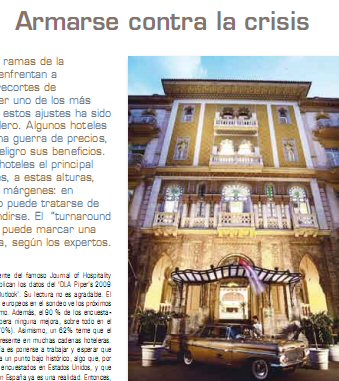
'Turnaround management', o cómo armarse contra la crisis

At Zaragoza Hotel Management School, we cooperated with Hotelschool the Hague Research (Jean-Pierre van der Rest) in the adaptation of his articles on Turnaround Management for the Spanish professional press (Hosteltur):

Para algunos hoteles el principal problema no es, a estas alturas de la crisis financiera y económica, mantener sus márgenes. En este momento puede tratarse de salvarse o hundirse. El  'turnaround management' puede marcar una gran diferencia, según los expertos. ¿Cuáles son sus respuestas a las 20 preguntas críticas que debería plantearse?
Hay muchas posibilidades para hacer frente a la crisis. Los profesores de Gestión Hotelera Dr. Jan Adriaanse (Universidad de Leiden), Dr. Jean-Pierre van der Rest (Escuela de Dirección y Administración Hotelera de La Haya), Dr. Frans van den Broek (Escuela de Dirección y Administración Hotelera de La Haya) y Dr. Jeroen Oskam (Escuela de Dirección Hotelera de Zaragoza), aseguran que es necesario aproximarse a la crisis desde el campo especializado del “turnaround management” o gestión para la reversión de la crisis, y aplicar este conocimiento en la práctica habitual de aquellos hoteles que aún siguen funcionando de manera saludable.

Thursday, September 24, 2009

Start of the European Bachelor of Hospitality Management

September 23, 2009: First start of this joint program. Pictures, news article and a news item on French TV3.
Studying in three countries, three languages and three cultures: today we inaugurated the new European Bachelor of Hospitality Management at L'École de Savignac, Savignac-les-Églises (close to Perigueux), France. The program, which leads to the BA Hons. awarded by the University of Brighton, starts in France, with its second year in Zaragoza, Spain, and the final year in Brighton, UK.


Inauguración Oficial European Bachelor of Hospitality Management (France 3)


Savignac-les-Églises, France.

Saturday, June 6, 2009

Recruitment Day Disneyland Paris

In cooperation with Disneyland Paris and INAEM (Government Employment Agency), ZHMS organized a recruitment day at national level, which attracted students from cities as far away as Vigo or Cádiz (1.000 kms.). In this fragment, Aragon TV interviews Rosa Maria Antunes (Disney Casting), several candidates and myself.